Banking sector sees strong asset growth amid solvency and credit risk concerns – Governor


By Eugene Davis
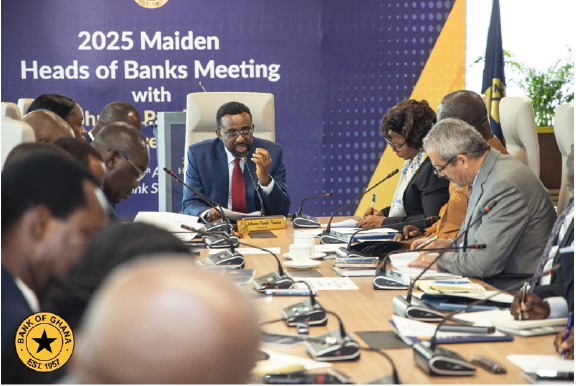
The banking sector recorded strong performance, with total assets expanding by 34.05% year-on-year as of end-February 2025. This growth was primarily funded by a 27.89% increase in deposits, according to the Governor of the Bank of Ghana, Dr. Johnson P. Asiama.
Speaking at a post-MPC engagement with CEOs of banks, the Governor affirmed the sector’s overall stability, with a Capital Adequacy Ratio (CAR) of 14.35%, well above the 10% regulatory minimum. However, he noted that a few state-owned and domestically controlled banks continue to face solvency challenges.
Addressing these capital shortfalls remains a top priority, with intensified supervisory engagement already underway.
Private sector credit is gradually recovering, though credit risk remains elevated. The Non-Performing Loans (NPL) ratio stood at 22.57% in February 2025. When fully provisioned loss-category loans are excluded, the adjusted NPL ratio was 8.93%. The Governor urged banks to strengthen their risk management practices, particularly in underwriting and provisioning.
He also highlighted the growing influence of fintechs and non-traditional players, stressing the need for banks to embrace innovation, enhance customer-centric services, and pursue strategic partnerships. The Bank of Ghana, he said, is committed to fostering a well-regulated, inclusive financial ecosystem that balances innovation with stability.
Dr. Asiama emphasized a shift toward forward-looking supervision, noting that the Bank is adopting a more proactive, risk-sensitive, and system-aware regulatory model. Key focus areas include:
Risk Identification & Mitigation: Leveraging data analytics and early warning systems to detect emerging threats such as asset quality deterioration, cybersecurity breaches, and systemic NPL buildup. He referenced the 2024 Fraud Report, which recorded a 5% increase in fraud cases and a 13% rise in value at risk—highlighting the need for stronger internal controls.
Digital Resilience: Banks are expected to align innovation with strong cybersecurity, operational resilience, and governance. Under the Cybersecurity Directive, institutions must invest in security, educate customers, and respond swiftly to fraud.
Governance & Compliance: Strong governance remains a cornerstone of sustainable banking. The Bank is intensifying scrutiny of board effectiveness and institutional accountability. Mandatory Basel III & IV training for bank directors is under consideration.
Regulatory Collaboration: The BoG aims to foster open, informed engagement with banks and policymakers to ensure market-sensitive, effective regulation.
Capacity Building: Supervisory teams are being upskilled to respond to emerging risks such as AI in finance, climate shocks, and geopolitical instability.
Sustainability Oversight: ESG and climate-related risks are now integrated into on-site examinations due to their growing influence on credit risk, reputational exposure, and long-term viability.
“Backward-looking supervision is no longer adequate,” the Governor stated. “Resilience depends on managing risks wisely and transparently, aligned with broader economic and environmental goals.”
He reiterated that banks play a vital societal role beyond capital management, directly impacting lives—whether supporting smallholder farmers, SMEs, or first-time account holders. Despite recent shocks from the financial sector clean-up and the DDEP, banks have demonstrated resilience and contributed to maintaining stability.
Looking ahead, he called for bold adaptation to shifting technologies, evolving customer expectations, and regulatory demands. Financial inclusion, he stressed, is not optional but essential.
“As we recover and reform, our actions must align with a long-term vision,” he concluded, reaffirming his six strategic priorities: strengthening monetary policy,maintaining exchange rate stability,deepening financial intermediation,advancing innovation and inclusion, enhancing policy coordination while preserving BoG’s independence and restoring the Bank’s equity position
“With your partnership,” Dr. Asiama said, “we can deliver a stronger, more resilient, and inclusive financial system for all Ghanaians.”