The New Currency of Corporate Resilience: How Ghanaian CFOs can lead in cost transformation amid inflation volatility



By Temilola Aderonke Onalaja, MBA, FCIFCON, FCLRM
Financial Strategist and Creator of the S.T.A.R. Strategy
Ghana’s persistent inflation and currency depreciation have imposed significant operational and financial strain on businesses. As of May 2025, inflation stands at 21.0%, and the policy rate remains elevated at 28.0% (Bank of Ghana, 2025; Ghana Statistical Service [GSS], 2025). This paper introduces a CFO-centered cost transformation framework grounded in Synergy, Technology, Analytical Precision, and Risk Mitigation (S.T.A.R.) to help Ghanaian companies build cost resilience and restore investor confidence. The framework expands on foundational financial theories such as Modigliani-Miller’s capital structure irrelevance principle and the cost stickiness model, adapting them to Ghana’s inflation-prone and structurally under-capitalized economy.
1. Inflationary and Currency Environment in Ghana (2025)
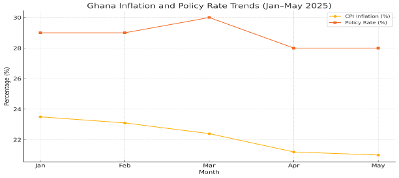
Figure 1: Monthly trends of CPI inflation and policy rate adjustments (GSS, 2025; BoG, 2025)
Ghana’s inflation rate has seen a gradual decline in early 2025, with consumer inflation falling from 23.5% in January to 21.0% by May (GSS, 2025). The Bank of Ghana, in response to earlier inflationary pressures, raised the monetary policy rate from 29.0% to 30.0% in March before reducing it back to 28.0% in April and maintaining it through May (Bank of Ghana, 2025).
This disinflationary path, while positive, continues to challenge corporate financial planning, especially among CFOs tasked with forecasting input costs and managing FX volatility under conditions of delayed price pass-through and policy lag effects (IMF, 2025). The environment also underscores the need for adaptive CAPEX planning. Empirical studies have shown that firms with flexible capital expenditure strategies are more resilient in inflationary contexts (Dittmar & Mahrt-Smith, 2007).
Structural Vulnerabilities in Corporate Cost Management
Many Ghanaian firms exhibit structural inefficiencies in cost governance:
- Annual budgeting cycles that misalign with monthly inflation volatility
- Manual procurement systems prone to inefficiencies
- Poor integration between finance and operational cost centers
These issues are amplified in SMEs, which face financing shortfalls of 50% to 150% (ResearchGate, 2024), leading to liquidity stress and fragile debt-servicing capacities. Additionally, empirical research on cost stickiness (Anderson, Banker, & Janakiraman, 2003) shows that in downturns, firms often struggle to proportionally reduce costs due to fixed overhead and inefficient cost structures. Ghanaian firms face similar limitations, necessitating transformation.
The S.T.A.R. CFO Cost-Transformation Framework
The S.T.A.R. strategy emerges as a pragmatic evolution of traditional cost and capital structure models by focusing on dynamic alignment, digital enablement, and real-time resilience.
Synergy
CFOs must implement cost councils across finance, procurement, and operations to decentralize cost visibility. This aligns with decentralization models in adaptive management literature (Mintzberg, 1979). For example, a Ghana-based agrifood processor reduced fuel-related downtime by 8% by embedding transport costs into weekly production scheduling.
Technology
Firms should adopt ERP and cloud-based budgeting tools to reduce lag and fraud. One manufacturer in Kumasi reduced month-end close time by 30% after deploying SAP Business One. These investments align with empirical data showing a 10–15% improvement in working capital cycle efficiency post-digitization (Accenture, 2023).
Analytical Precision
CFOs should move beyond static variance analysis and implement ABC (Activity-Based Costing) with monthly inflation scenarios. Predictive stress testing based on 5–15% inflation brackets improves decision-making. This method reflects the growing use of scenario-based planning in high-volatility economies (Harvard Business Review, 2022).
Risk Mitigation
Shift from fixed to semi-variable cost structures. For instance, outsourcing non-core logistics allowed a local diagnostic firm to reduce overheads by 12%. These adjustments are consistent with Modigliani-Miller’s proposition that firms should aim for optimal capital flexibility when financial markets are imperfect or inflation-distorted.
Investor-Driven Implications
Investor sentiment is increasingly driven by cost agility. Structured cost models improve DSCR ratios (Debt Service Coverage Ratio), lift EBITDA margins, and signal disciplined governance. Firms with quarterly inflation-adjusted KPIs are better positioned for private equity and DFI engagement. Recent literature supports that investor confidence increases when firms actively demonstrate financial agility during macroeconomic shocks (McKinsey, 2023).
5. Policy Recommendations
- Expedite VAT refunds for firms implementing cost-control frameworks
- Incentivize ERP and financial training for SMEs
- Encourage banks to offer working capital tied to cost-transparency metrics
Conclusion
Cost transformation is not optional in Ghana’s inflation-prone economy. Ghanaian CFOs must embrace the S.T.A.R. strategy to institutionalize visibility, resilience, and investor trust. The framework complements and extends traditional financial theories by integrating local contextual variables such as FX shocks, tax refund delays, and input volatility into a decision-making model. CFOs that lead in this domain will shape Ghana’s next generation of globally competitive companies.
References
Accenture. (2023). Digitizing Finance Operations: Africa Edition. Retrieved from https://www.accenture.com
Anderson, M., Banker, R., & Janakiraman, S. (2003). Are Selling, General, and Administrative Costs “Sticky”?. Journal of Accounting Research, 41(1), 47–63.
Bank of Ghana. (2025). Monetary Policy Report – May 2025. Retrieved from https://www.bog.gov.gh
Dittmar, A., & Mahrt-Smith, J. (2007). Corporate Governance and the Value of Cash Holdings. Journal of Financial Economics, 83(3), 599–634.
Ghana Statistical Service. (2025). Consumer Price Index Summary – April 2025. Retrieved from https://statsghana.gov.gh
Harvard Business Review. (2022). Managing Through Inflation: CFO Strategies for 2023 and Beyond. Retrieved from https://www.hbr.org
International Monetary Fund. (2025). Article IV Consultation Staff Report: Ghana. Retrieved from https://www.imf.org/en/Publications/CR/Issues/2025/
McKinsey & Company. (2023). Resilience in Financial Strategy Amid Global Shocks. Retrieved from https://www.mckinsey.com
Mintzberg, H. (1979). The Structuring of Organizations. Prentice-Hall.
PwC Ghana. (2024). The CFO Agenda: Managing Cost in a Volatile Ghanaian Economy. Retrieved from https://www.pwc.com/gh
ResearchGate. (2024). Problems of Financing SMEs in Ghana. Retrieved from https://www.researchgate.net/publication/371274921_Problems_of_Financing_SMEs_in_Ghana