
By Ebenezer Sasu
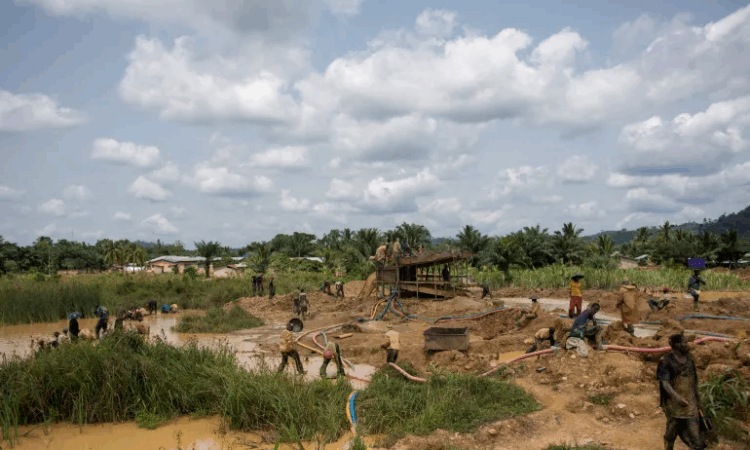
In recent years, Ghana has emerged as a cautionary tale of how a country’s natural wealth can be both a blessing and a curse. The country’s mining industry is one of the sectors that provide a perfect test case to back this analogy. What is known as illegal small-scale mining, locally referred to as ‘galamsey’, has rapidly become a national crisis and a bane of the West African country’s sustainable development. Despite the political will of successive governments to curtail this phenomenon, such efforts have not yielded the desired results, as the canker continues to spread like wildfire, leaving devastated forests, poisoned rivers, divided communities, and an increasing public mistrust of the state’s capacity or even its disposition to enforce the law.
A wound on the land and water
Throughout the country, in places like Ashanti, Western, Eastern, and Central, large, arable pieces of land have been ruined and left unsuitable for both agriculture and human habitation. Refuge forests for biodiversity have been transformed into open pits. Even more disturbing is the pollution of the country’s main rivers – Pra, Ankobra, Offin, and Birim – which have been the source of water and livelihood for millions of Ghanaians for decades. These water bodies even served as sources of drinking water and irrigation for local residents, but they can no longer serve this purpose as the galamsey activities have discoloured and rendered them toxic because of the introduction of mercury and cyanide, harmful chemicals used by galamsey operators in their activities. Villages affected directly by this disturbing situation are at risk of serious and deadly health conditions. In several instances, the Ghana Water Company has been compelled to close down treatment plants as a result of extreme pollution, escalating water shortages in urban areas. Yes, this is clearly not a mere environmental issue but a public health emergency.
Powerful hands behind the shovels
What makes galamsey so difficult to fight isn’t just how extensive it is, but the powerful interests behind it. Reports and investigations have indicated that the illicit mining industry is not merely a desperate youth phenomenon but is supported by a vast network of politicians, chiefs, affluent business people, most of whom are foreigners, and even, sadly, some within the security services.
Arrests are rare in many communities, and prosecutions fail, or never take place. Machinery confiscated from galamsey sites goes missing or is given back to the owners under the cover of darkness. Worst yet, suspected financiers of illegal mining are left off the hook while the poor young men and women they hire bear the brunt of police arrests. This, no doubt, has emboldened perpetrators of this heinous crime, fostered impunity as it sends a reckless message that the law is negotiable and damaging the environment comes at no consequences, so long as you know the right people.
Weak enforcement, weaker will?
In the past, several programmes have been birthed to sort of end this menace. The erstwhile government introduced Operation Vanguard and Operation Halt to stop illegal mining. Presidents have talked tough, ministers have promised zero tolerance, media houses have exposed rot, and the current government has also introduced the use of drone technology to monitor and manage mineral resources. Despite these programmes, the galamsey beast remains – some arguing that it is even more menacing now than ever before. This raises an alarming question: Is the state committed to fighting this, or has the involvement of some political bigwigs crippled the state of its supreme powers? It is important to highlight that the laws to deal with this phenomenon already exist. The Mineral and Mining Act, the Environmental Protection Agency Act, and various other legislative instruments define what is legal and illegal mining.
So, it is not a matter of laws or regulations anymore; it’s gone beyond that now. What is lacking is the political will, especially when those in the frame are connected to the powers that be. The cost of inaction, the price of doing nothing, extends beyond the fouled rivers and scarred landscapes. It is economic – lost revenue from illicit gold exports; it is social – heightened conflict in mining communities; it is political – the erosion of public trust in government institutions. And most perilously of all, it is generational – the impact it will have on sustainable development and the future generation. Today’s damage will not be repaired in centuries, if it ever is. Rich in culture and ample in gold, Ghana is slowly bleeding to death from self-inflicted cuts from greedy people.
Conclusion
Galamsey is not simply an environmental or criminal problem – it’s a test of Ghana’s moral and political fibres. The question that Ghanaians are asking is: “Is the government really powerless to stop illegal mining, or is it only tongue-tied?” Until that question is answered in actions, not just in words, the rivers of this nation will continue to flow in the colour of gold.

About author
He is a freelance writer and commentator who focuses on political, environmental, and social issues impacting Ghana, with a commitment to promoting informed dialogue and change.