Mahama to UNGA: Africa must exercise sovereignty over its natural resources


By Eugene Davis
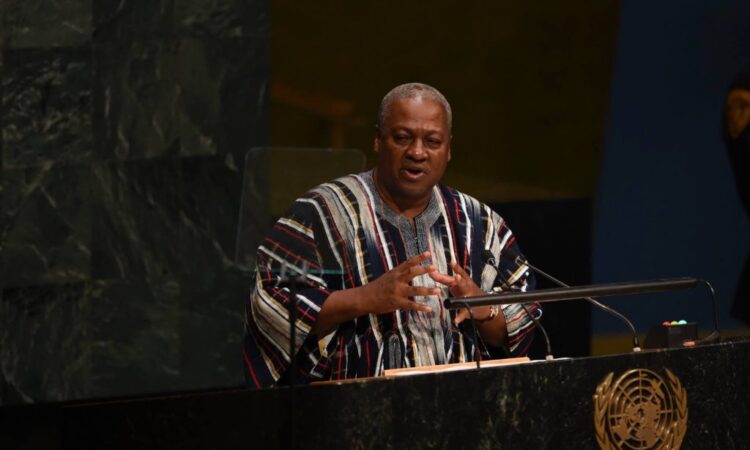
President John Mahama has told world leaders gathered at the 80th Session of the United Nations General Assembly (UNGA 80) in New York, USA that Africa wants to keep more of the benefits from its natural resources.
Natural resources, including gold, bauxite, copper, oil and gas, as well as critical minerals such as lithium, graphite and manganese are in huge global demand and remains critically important for the continent’s economic growth.
According to him, it is time the continent exercise sovereignty over its natural resources.
The President lamented that since July 2024, humanitarian aid to Africa has dropped by 40%, a stark reminder of the continent’s vulnerability. He stressed that while Africa welcomes foreign investment, future agreements must ensure fairer terms, stronger local content, and greater respect for African dignity.
He told the Assembly “In this era of global uncertainty, Africa must exercise sovereignty over its natural resources to raise the necessary funds to ensure the well-being of its citizens.
The days of parceling out vast concession areas to foreign interests for exploitation must come to an end. We will continue to welcome foreign investment, but we must negotiate better for a bigger share of the natural resources that belong to us.
Ghana’s President said with the era of colonialism now in the past, Africa are tired of bad narratives “We are tired of the continued image of poverty-stricken, disease-ridden rural communities, living at the periphery of huge foreign-controlled natural resource concession areas.
We are tired of having people extract the most they can from us and, in return, offer us the very least by way of respect, consideration, and dignity.
We are tired of not being represented in ways that reveal the richness and complexity of our history or acknowledge all that we have overcome to arrive here, in this liminal space of untold possibilities.”
On Ghana’s part, reforms are being implemented to the country’s Minerals and Mining Policy and Act, with a focus on sustainability, community engagement, and maximizing local benefits.
Analysts note that resource-rich African nations often suffer deeper economic inequalities than their peers, with South Africa—one of the most unequal countries in the world—frequently cited as an example, following miners’ strikes and persistent wage disputes. Endemic corruption further compounds these challenges.
Nigeria, Africa’s largest oil producer, underscores this paradox. Since independence in 1960, an estimated $400 billion in oil revenue has been stolen or mismanaged, according to former World Bank vice-president for Africa, Oby Ezekwesili. That figure is 12 times the country’s 2011 national budget, while today, nearly 90% of Nigerians survive on less than $2 a day.
Conflicts over resources remain widespread. Violence erupted between Sudan and South Sudan over oil this year, while Malawi and Tanzania continue to clash over ownership of oil and gas deposits in Lake Malawi. Ghana, which began oil production in 2010, joins a long list of West African nations pushing further exploration, as only five of Africa’s 54 countries are not engaged in oil production or exploration.
From Algeria to Angola, and from petroleum to platinum, iron ore to ocean wealth, the scramble for Africa’s resources has fueled instability more often than prosperity. Much of the profits are repatriated by foreign-owned companies that dominate extraction while paying minimal taxes.
Few African nations process their own raw materials; instead, value addition occurs overseas, denying local economies jobs and revenue. Foreign firms are often criticized for creating little local employment or meaningful community investment.
Meanwhile, global powers continue to tighten their grip on Africa’s wealth. In 2022, China-Africa trade surged to a record $282 billion—a rise of 11% from the previous year—driven by strong demand for oil, copper, cobalt, and iron ore. That figure is nearly four times the $72.6 billion in US-Africa trade. Yet, as Florizelle Liser of the Corporate Council on Africa observed, more manufactured and value-added products flow from Africa to the US than to China, underscoring the continent’s ongoing struggle to control the full value chain of its resources.