Kumasi Mayor appeals for more central gov’t support despite GH₵29.3 million IGF gains


By Eugene Davis
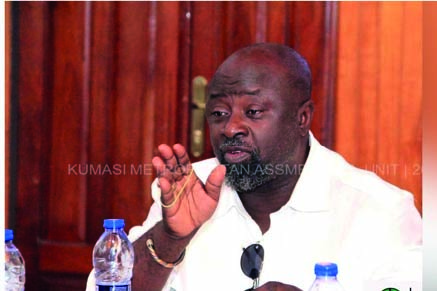
The Mayor of Kumasi, Richard Ofori Agyemang Boadu, has revealed that the Kumasi Metropolitan Assembly (KMA) has so far generated GH₵29.3 million in internally generated funds (IGF) for the year. However, he appealed for additional financial support from central government to enable the Assembly to function more effectively.
Appearing before Parliament’s Local Government Committee to respond to issues raised in the 2024 Auditor-General’s Report, Mr. Agyemang Boadu explained that the Assembly’s growing responsibilities, coupled with urban expansion, require greater budgetary support.
“What we have received so far has helped, but if we get a little more, it will enable us to function more effectively,” he said. “We have five constituencies, and if you look at the allocation, it becomes a challenge.”
Sanitation and Waste Management Pressures
The Mayor disclosed that Kumasi produces over 2,000 tonnes of waste daily, with each tonne costing about GH₵83 to manage. He highlighted that the KMA has made significant progress in improving the welfare of sanitation workers.
“When I assumed office, night cleaners were earning GH₵350 a month. We have now increased that to GH₵820, while supervisors receive GH₵1,000,” he told the committee. “We have improved their salaries by more than 100 percent, and I personally supervise their work at night.”
Despite these efforts, sanitation and decongestion remain major challenges due to ongoing market redevelopment projects that have displaced many traders onto the streets.
“If I am to remove everyone from the pavements now, we will face serious difficulties. Kumasi is a hub of trade and commerce, so we are managing the situation until the new markets are completed,” he explained.
Market Redevelopment and Decongestion Efforts
According to the Mayor, ongoing redevelopment works at the Krofrom Market are expected to be completed by December 2026 following a directive from the President and the Ashanti Regional Minister.
“Once the Krofrom Market is completed, we will relocate over 4,000 traders from the central business district. The market will have 2,900 open sheds and 300 lockable ones,” he noted.
He further indicated that the second phase of the Kumasi Central Market will follow within two years, adding that “when both projects are completed, there will be no justification for traders to sell on the streets.”
Restoring Kumasi’s ‘Garden City’ Image
Mr. Agyemang Boadu also outlined plans to restore Kumasi’s historic reputation as ‘The Garden City of West Africa.’ He disclosed that provisions have been made in the 2026 budget for a new public garden and recreational facility around the Ridge area.
“We want to give Kumasi the right image once again — a clean, green city that promotes tourism, recreation, and environmental pride,” he said.
Population and Administrative Context
The Mayor told the committee that while the official geographic population of Kumasi stands at about 495,000, the city’s functional population exceeds 2 million, as it serves as the commercial and administrative hub for the Ashanti Region and parts of northern Ghana.
The Kumasi Metropolitan Assembly, one of Ghana’s six metropolitan assemblies, is mandated to oversee local governance, planning, sanitation, and infrastructural development within the metropolis.
Upon assuming office, Mr. Agyemang Boadu initiated key urban renewal projects, including the Kejetia Market Phase II and Krofrom Market redevelopment.
However, the KMA continues to grapple with rapid urbanization, funding constraints, waste management challenges, and enforcement difficulties, particularly concerning street trading and informal settlements.