
By Eugene Davis
The Minority Caucus in Parliament has cautioned government against rushing the passage of a proposed Legislative Instrument (L.I.) under the Minerals and Mining (Royalties) Regulations, 2025, arguing that the current draft could shortchange Ghana and weaken the country’s ability to derive fair value from its mineral resources.
The proposed L.I. seeks to introduce a sliding-scale royalty regime for gold, lithium and other minerals, linking royalty rates to international commodity prices. Government says the framework is intended to make the fiscal regime more responsive to price movements. However, the Minority insists the design and timing of the instrument raise serious policy, governance and economic concerns.
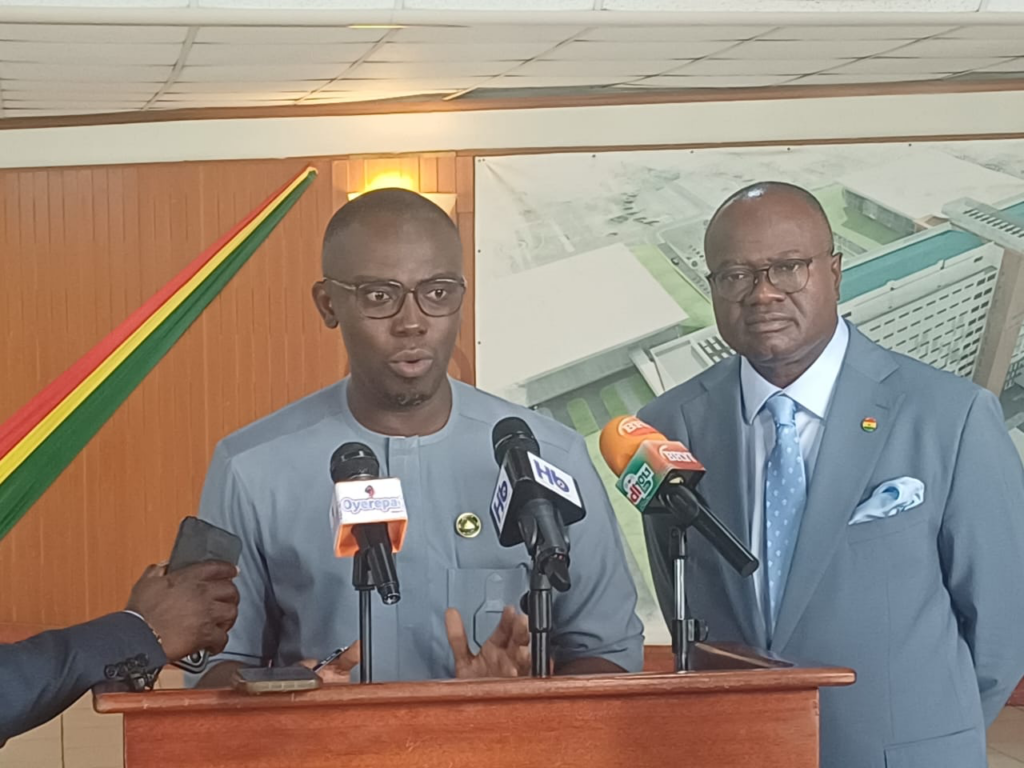
Speaking on the matter, Deputy Ranking Member on the Lands and Natural Resources Committee, Mr Akwasi Konadu, described the draft L.I. as fundamentally flawed.
“We believe the L.I. as it stands is not fit for purpose and will not give Ghanaians the full benefit of our natural resource exploration,” he said.
Committee Yet to Be Briefed
Mr Konadu revealed that despite the urgency with which the L.I. is being pushed, the Lands and Natural Resources Committee itself has not held a formal meeting to be briefed on the rationale, structure and implications of the proposed sliding-scale regime.
“We have received a copy and studied it ourselves. These concerns are not political; they are raised in the national interest,” he stressed.
He acknowledged that delays in concluding the lithium framework—particularly around the Ewoyaa project—have affected livelihoods in affected communities, but argued that this should not justify hurried legislation.
Lithium Moratorium and Policy Inconsistencies
The Minority recalled that in December 2023, government placed a moratorium on lithium-bearing lands, effectively suspending livelihoods in those areas while negotiations were ongoing. More than a year later, they say, affected communities are yet to see clarity or closure.
Mr Konadu also highlighted policy inconsistencies, noting that when the lithium lease agreement was first presented to Parliament under the previous administration, the Majority—then in opposition—blocked ratification, insisting that a 10 per cent royalty was appropriate.
“Now, we are told 10 per cent is illegal, and suddenly five per cent is acceptable—and they still want to rush it through,” he said.
Price-Based Royalties Could Lock Ghana into Lower Returns
A central concern of the Minority is that the proposed sliding scale anchors the base royalty at five per cent, rather than legislating from the previously agreed 10 per cent.
Under the draft L.I.:
Gold royalties start at 5 per cent for prices up to US$1,900 per ounce, rising incrementally in US$100 bands.
Lithium royalties begin at 5 per cent for prices up to US$1,500 per tonne, only reaching 10 per cent at prices close to US$3,200 per tonne.
Other minerals remain fixed at 5 per cent.
The Minority argues that this structure allows royalty rates to fall back to lower levels when prices decline, effectively boxing Ghana into a weaker negotiating position.
“If prices fall below the current thresholds, we automatically revert to five or six per cent. That is not how you negotiate for a country,” Mr Konadu stated.
They insist that if government’s own argument is that a 10 per cent royalty must be legislated to be enforceable, then the base of the sliding scale should start at 10 per cent, not five.
Discretion Without Benchmarks Raises Red Flags
The Minority also raised concerns about the proposed mechanism for determining prices, particularly where the L.I. allows for “mutual agreement” on price benchmarks should recognised indices—such as the London PM Fix (LBMA)—be unavailable.
“How do you mutually agree on a price without a clear benchmark?” Mr Konadu questioned.
“Too much discretion has already taken us from 10 per cent to five. Leaving this open-ended is dangerous.”
They warned that excessive ministerial discretion could expose the regime to abuse and undermine transparency.
Sliding Scale Seen as One-Sided
While acknowledging that sliding-scale royalties are not inherently problematic, the Minority argued that the proposed framework only adjusts upward, with no downside protection for the state and no counter-cyclical balance.
They noted that government shares no downside risk when prices fall, yet industry benefits from reduced royalties—an asymmetry they say defeats the purpose of a progressive fiscal regime.
Lithium Lease Withdrawal Adds Context
The debate unfolds against the backdrop of government’s decision on December 11, 2025, to withdraw the lithium mining lease involving Atlantic Lithium (Barari DV Ghana Limited) from Parliament for further consultations.
The withdrawal followed sustained objections from civil society, lawmakers and industry players over the proposed reduction of royalties from 10 per cent to five per cent and concerns about weak local value addition.
Government cited the sharp over 80 per cent decline in global lithium prices since 2022 as justification for the lower rate, arguing that project viability was at risk.
Call for Caution and Proper Engagement
The Minority insists that government must slow down, deepen consultations and avoid triggering the constitutional 21-day automatic maturity process for L.Is., which would make reversal difficult without a two-thirds parliamentary majority.
“We should not legislate in haste just to say something has been done. This country risks losing the full benefit of its mineral discoveries,” Mr Konadu warned.
They are calling for a more deliberate, transparent and value-driven approach that safeguards Ghana’s long-term interests while ensuring fairness, predictability and credibility in the mining fiscal regime.