UAE economy demonstrates strong fiscal resilience and retains AA/A-1+ credit rating


The current geopolitical tensions in the Middle East have once again placed the global energy market and regional economies under intense scrutiny. Conflicts in the region often disrupt trade routes, raise oil prices, and create uncertainty across financial markets. Yet amid this environment, the economy of the United Arab Emirates (UAE) continues to demonstrate notable fiscal resilience and macroeconomic stability. Recent economic indicators and credit assessments suggest that the UAE possesses the structural strength necessary to withstand regional volatility while maintaining investor confidence and economic momentum.
A Strong Fiscal Foundation
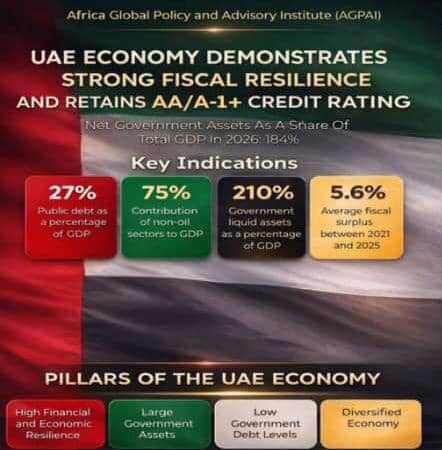
One of the most striking features of the UAE’s economic position is the strength of its public finances. According to recent assessments by S&P Global Ratings, the UAE maintains an AA/A-1+ sovereign credit rating with a stable outlook, reflecting strong fiscal and external balances and confidence in the government’s economic management.
A key indicator of this strength is the country’s consolidated net government asset position, estimated to reach 184% of GDP in 2026. This means that government-owned assets significantly exceed public liabilities, providing a powerful fiscal buffer during periods of economic stress or geopolitical disruption.
In addition, the UAE holds government liquid assets estimated at around 210% of GDP, reflecting the scale of sovereign wealth funds and public investment vehicles managed primarily by institutions such as the Abu Dhabi Investment Authority and other state-backed funds. These financial reserves allow the government to respond flexibly to external shocks without jeopardizing fiscal stability.
Another pillar of resilience is the country’s relatively low public debt, which stands at roughly 27% of GDP, far below the levels seen in many advanced economies. Over the past several years, the UAE has also maintained strong fiscal discipline, recording an average fiscal surplus of about 5.6% of GDP between 2021 and 2025.
These indicators collectively demonstrate that the UAE has substantial financial capacity to manage both economic downturns and geopolitical shocks.
Economic Diversification Reducing Oil Dependence
Historically, Gulf economies were heavily dependent on hydrocarbons. However, the UAE has pursued an ambitious economic diversification strategy over the past two decades. Today, non-oil sectors contribute approximately 75% of the country’s GDP, including trade, logistics, tourism, aviation, financial services, and technology.
This diversification significantly reduces the vulnerability of the economy to oil price volatility. While hydrocarbons remain an important revenue source, the broader economic structure ensures that growth can continue even during fluctuations in global energy markets.
Major trade agreements and strategic partnerships have also strengthened the UAE’s role as a global economic hub. Comprehensive Economic Partnership Agreements with countries such as India, Indonesia, and Turkey have expanded trade and investment flows, reinforcing the UAE’s position as a critical bridge between Asia, Africa, and Europe.
Navigating Conflict and Market Volatility
The ongoing conflict involving Iran and several regional actors has introduced uncertainty into global markets. Oil prices have reacted sharply to the risk of supply disruptions, particularly due to threats to major shipping routes such as the Strait of Hormuz. In some cases, oil prices have surged by more than 10 percent during periods of heightened tension.
Despite these challenges, the UAE’s economic architecture provides considerable protection. Analysts emphasize that the country’s large fiscal reserves and policy flexibility allow it to absorb temporary disruptions in oil production, exports, or global demand.
Furthermore, the UAE has invested heavily in energy infrastructure that reduces dependence on vulnerable maritime routes. The Abu Dhabi Crude Oil Pipeline connecting to Fujairah on the Indian Ocean allows a significant portion of oil exports to bypass the Strait of Hormuz, thereby minimizing the risk of supply disruption during geopolitical crises.
Although regional tensions may temporarily slow sectors such as tourism or real estate, economists expect the UAE’s diversified economic base and strong balance sheet to support a rapid recovery once geopolitical conditions stabilize.
The Role of Sovereign Wealth and Financial Institutions
Another critical element supporting the UAE’s resilience is the strength of its financial system. The country’s banking sector remains highly capitalized and liquid, supported by large sovereign wealth reserves and stable macroeconomic policies. Analysts expect continued growth in lending and investment activities across 2026 and 2027 due to ample liquidity in the banking system.
Sovereign wealth funds also play a strategic role in global investment markets. These funds provide long-term capital for infrastructure, technology, renewable energy, and strategic assets worldwide. Their presence reinforces the UAE’s global economic influence and strengthens domestic financial stability.
Implications for the Global Economy and Africa
The fiscal resilience of the UAE has broader implications beyond the Gulf region. As one of the world’s major energy exporters and financial hubs, the UAE contributes to stabilizing global oil markets during geopolitical crises. By maintaining steady production and investing in energy infrastructure, Gulf producers can moderate supply shocks that might otherwise lead to extreme price volatility.
Stable energy markets are particularly important for developing economies, including those in Africa. Many African countries rely heavily on imported petroleum products for transportation, electricity generation, and industrial production. When oil prices spike sharply, inflation increases and fiscal pressure intensifies.
By helping maintain supply stability and moderating price volatility, Gulf energy producers indirectly support economic stability in Africa. Moreover, Gulf sovereign wealth funds are increasingly investing in African infrastructure, ports, logistics networks, and renewable energy projects. These investments deepen economic ties between the Gulf and Africa while supporting development across the continent.
Strengthening Africa-Gulf Relations Amid Middle East Tensions
The fiscal resilience and economic stability demonstrated by the United Arab Emirates and other members of the Gulf Cooperation Council create important opportunities for strengthening Africa-Gulf relations even during periods of geopolitical tension in the Middle East. Stable Gulf economies provide both economic confidence and strategic partnership opportunities for African countries.
Energy Market Stability and Economic Cooperation
The ability of Gulf states to stabilize global oil markets during periods of geopolitical tension strengthens economic cooperation between Africa and the Gulf. Many African countries depend heavily on imported petroleum products for transportation, electricity generation, and industrial activities. When Gulf producers maintain steady supply and moderate oil prices despite regional conflicts, it reduces inflationary pressure in African economies. This stability fosters trust in Gulf energy producers and strengthens long-term energy partnerships, encouraging African governments to deepen cooperation in energy security, fuel supply agreements, and strategic reserves management.
Expansion of Gulf Investments in African Economies
Strong fiscal resilience in Gulf economies allows sovereign wealth funds and investment institutions to continue expanding investments in Africa even during geopolitical uncertainty. Gulf states have increasingly invested in African infrastructure, logistics corridors, ports, agriculture, renewable energy, and financial services. Stable government revenues from hydrocarbons enable these countries to maintain outward investment flows despite regional tensions. As a result, African countries benefit from capital inflows that support industrial development, job creation, and modernization of infrastructure, strengthening long-term economic ties between the two regions.
Strengthening Strategic Trade and Logistics Partnerships
The Gulf region serves as a critical global logistics hub connecting Asia, Europe, and Africa. During periods of geopolitical tension, resilient Gulf economies maintain stable trade corridors and supply chains that benefit African exporters and importers. Major ports and aviation hubs in the Gulf continue to facilitate African trade flows, including agricultural exports, minerals, and manufactured goods. This logistical connectivity reinforces Africa-Gulf commercial relations, helping African economies maintain access to global markets while strengthening the Gulf’s role as a gateway for African trade.
Enhanced Financial and Development Cooperation
The strong banking systems and sovereign wealth reserves of Gulf states enable them to support development financing initiatives across Africa. During periods of geopolitical instability, financially resilient Gulf economies are better positioned to provide concessional financing, development loans, and infrastructure funding. Gulf-based development funds and financial institutions increasingly collaborate with African governments to finance large-scale projects such as ports, energy infrastructure, housing, and digital connectivity. These partnerships deepen economic diplomacy and position Gulf states as important development partners for African nations.
Strengthening Diplomatic and Strategic Partnerships
Shared economic interests amid global instability encourage deeper diplomatic engagement between African and Gulf states. When Gulf economies demonstrate resilience and responsible management of energy markets during conflict, African governments recognize the strategic importance of maintaining strong political relationships with Gulf partners. This often leads to expanded diplomatic cooperation in areas such as trade policy, energy security, climate transition, and regional stability. As these partnerships grow stronger, Africa and the Gulf increasingly view each other as long-term strategic allies in global economic and geopolitical affairs.
Looking Ahead
Despite ongoing geopolitical tensions, the UAE’s economic outlook remains fundamentally strong. With large fiscal buffers, low debt levels, diversified economic sectors, and robust financial institutions, the country is well positioned to navigate regional instability.
The combination of prudent fiscal management, strategic diversification, and global economic integration has transformed the UAE into one of the most resilient economies in the Middle East. In an era defined by geopolitical uncertainty, the UAE’s economic model demonstrates how strong financial fundamentals and long-term planning can sustain stability even in the face of conflict.
As the global economy continues to confront geopolitical shocks and energy market volatility, the fiscal resilience of the UAE will remain an important pillar not only for regional stability but also for the broader global economic system.