
By Edward Adjei Frimpong
Rising tidal waves along Ghana’s eastern coastline are destroying fishing boats, washing away homes and cutting off incomes in vulnerable coastal communities in the Volta Region, where thousands of artisanal fishers are struggling to survive as climate-driven coastal erosion accelerates.
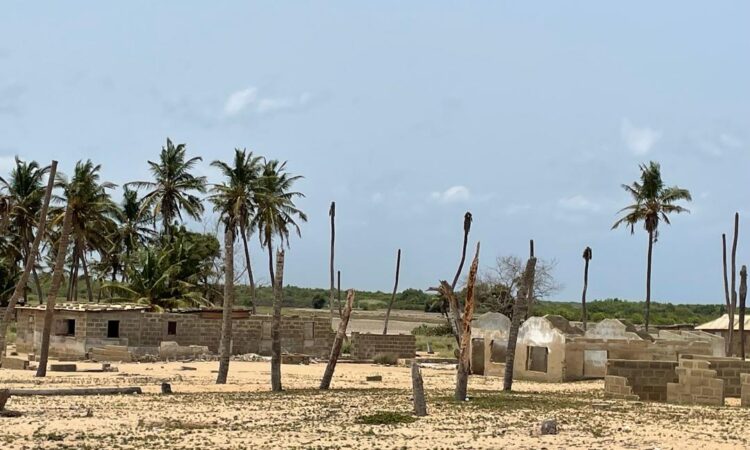
In fishing settlements such as Fuveme, Dzaflagbe, Agavedzi and Salakope in Anloga and Ketu South Districts, repeated tidal waves have destroyed homes, submerged roads and swept away canoes and fishing nets, undermining the artisanal fishing economy that sustains most households.
The worsening coastal erosion is not only displacing families but also disrupting fish landings, threatening food security and pushing already poor fishing households deeper into economic distress in one of Ghana’s most climate-vulnerable coastal zones.
In the Anloga District, some of the worst affected communities include Fuveme and Dzaflagbe, where the advancing sea has crippled local fishing activities. Canoes and fishing nets have been destroyed, while homes, fish landing sites and community infrastructure have been washed away by tidal waves linked to rising sea levels.
The destruction has severely disrupted fishing operations, depriving households of income and threatening food security in communities where fishing remains the main source of livelihood. With fishing equipment destroyed and landing beaches damaged, many fisherfolk are unable to go to sea, leaving families with little means of survival.
Residents say shoreline erosion has worsened significantly over the years. The latest tidal wave incident on April 26, 2026, further eroded the narrow land barrier separating the Atlantic Ocean from the Volta River estuary near Ada, increasing fears that entire communities could be submerged if urgent intervention is delayed.
The disaster has displaced hundreds of people, many of whom are now sheltering in makeshift structures in nearby coconut groves, while others have moved in with relatives in neighbouring communities such as Atiteti and Atorkorkodzi, which are also threatened by the advancing sea.
A fisherman at Fuveme, Jackson Akorli, said the waves had washed away a sandbar residents had constructed as a temporary barrier against the encroaching sea, drastically reducing the natural protection for homes and fishing grounds.
He added that the erosion also threatens inland fishing activities across the Keta Lagoon, warning that seawater intrusion could alter breeding conditions for tilapia and mudfish, the main fish species sustaining inland fishing economies.
For fishing households, the impact extends beyond the loss of shelter. Women involved in fish processing and trading are also facing declining incomes as reduced fish landings disrupt the local fish value chain. The combined loss of boats, gear, markets and homes is eroding the economic foundation of these communities and raising fears of long-term migration and worsening poverty.
The Atiteti-Fuveme Representative of the Ghana National Canoe Fishermen Council, Amos Agboado, said the construction of sea defence infrastructure was essential to preserving the fishing economy in the affected communities.
“The major intervention needed now is the construction of sea defence to protect the affected communities from further destruction. Without the sea defence, we cannot continue fishing here,” he said.
Mr. Agboado ruled out relocation as a sustainable option, saying moving fishing communities inland would deprive residents of their only viable livelihood.
“Relocation is not the ideal option because it will deprive the people of their only source of livelihood — fishing,” he said.
He also called for the dredging of sections of the Volta River estuary, arguing that sediment build-up had reduced its ability to absorb tidal surges, worsening seawater overflow and shoreline erosion.
The crisis in the Volta Region reflects the growing threat climate change poses to Ghana’s artisanal fisheries sector, which remains a major source of employment, food security and rural income. As sea levels rise and erosion intensifies, coastal fishing communities are becoming increasingly exposed to environmental shocks that threaten both livelihoods and the sustainability of local economies.