Automotive sector stalled by policy inaction, Rana Motors boss tells Parl’s Trade Committee


By Eugene Davis
The Chief Operations Officer of Rana Motors, Mr. Kassem M. Odaymat, has renewed calls for the government to fully enforce critical components of the Ghana Automotive Development Policy (GADP), including a proposed 35% import duty on used vehicles aged 1–5 years.
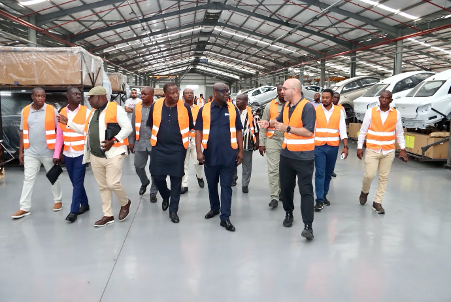
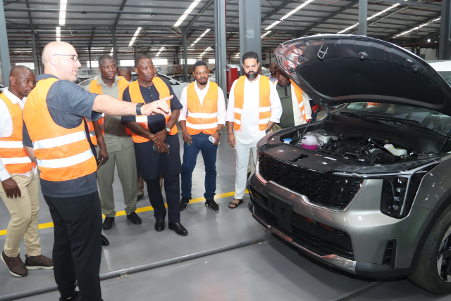
Speaking during a working visit by the Parliamentary Select Committee on Trade, Industry and Tourism to the Rana Motors Assembly Plant in Accra, Mr. Odaymat underscored the urgent need for policy enforcement to protect local assemblers and stimulate the growth of Ghana’s budding automotive sector.
“Implement the 35 percent on the vehicles which are between one and five years at the beginning. Let’s allow the population who doesn’t have the purchasing power to continue purchasing the five to ten-year-old cars under the old regime. This way, we’re protected as assemblers, because those buying one or two-year-old cars are essentially buying almost new. Why not buy a brand-new assembled vehicle that meets Ghana’s specifications?” Mr. Odaymat proposed.
He emphasized that while the GADP was launched in 2019 to position Ghana as a West African automotive manufacturing hub, key provisions remain unimplemented, severely restricting the industry’s potential.
“Today, we are operating at just a fraction of our full capacity. We could easily multiply our output and workforce if the policy was fully implemented,” he said.
Call for Ban Enforcement and fair standards
Mr. Odaymat, who also serves as President of the Ghana Automobile Distributors Association, additionally called for the enforcement of a ban on used vehicle imports older than 10 years, the application of the 35% duty on 1–5-year-old vehicles, and the strict implementation of homologation standards by the Ghana Standards Authority (GSA).
“We, the new vehicle assemblers, are bearing the cost of homologation. Yet, many imported used vehicles are not being subjected to the same standards. That is unfair and counterproductive to the policy’s goals,” he stressed.
He noted that assemblers had made concessions by accepting that vehicles aged 5–10 years could continue under the current tax regime, but insisted that at minimum, the 35% duty should apply to newer used cars to create a level playing field.
Mr. Odaymat described current enforcement as inconsistent and skewed, citing instances where new vehicles are being charged inspection fees, while imported used vehicles bypass required safety and standards checks.
Capacity, Expansion & Component Manufacturing Potential
Touching on Rana Motors’ long-term vision, Mr. Odaymat revealed that the company’s facility is equipped to support all levels of assembly—from Semi Knocked Down (SKD) to Complete Knocked Down (CKD).
He disclosed that the plant currently has the infrastructure to produce 35,000 units annually, with potential to scale to 75,000 units, provided market conditions and policy implementation improve.
Looking ahead, he emphasized component manufacturing as the next growth frontier, pointing out its massive employment potential.
“Component manufacturing could employ 10 to 20 times more people than vehicle assembly itself. But investors need assurance of volume—and that comes from a fully functioning and enforced policy,” he said.
Parliamentary support and commendation
The Chairperson of the Parliamentary Select Committee, Hon. Hottordze Roosevelt Alexander, praised Rana Motors for its high local content and contribution to national employment, particularly among engineers and young professionals.
“Our dream is to make sure every Ghanaian youth, regardless of background, gets something doing. Seeing a company like this employing our people makes us very happy,” he remarked.
He assured that the committee had taken note of all the challenges raised and would engage with the appropriate authorities to address them.