
By Eugene Davis
Ghana’s opposition NPP Minority has escalated its challenge to a recent High Court decision affecting the Office of the Special Prosecutor (OSP), warning that the ruling risks undermining both the country’s anti-corruption architecture and the balance of constitutional authority.
At the centre of the dispute is the role of the Attorney-General. The Minority argues that it is constitutionally troubling for the state’s chief legal officer to appear, in effect, aligned against a statutory body of the Republic in ongoing judicial proceedings—without first accounting to Parliament. They say they will summon the Attorney-General and, if necessary, push for a formal parliamentary inquiry.
The immediate trigger is a High Court ruling that questioned the prosecutorial authority of the OSP. The Minority insists the decision should be urgently appealed and stayed, warning that allowing it to stand—even temporarily—could paralyse ongoing corruption cases. They are also urging the Supreme Court to fast-track its determination in the related constitutional case, Adamtey v. Attorney-General, which they see as the proper forum for resolving the matter.
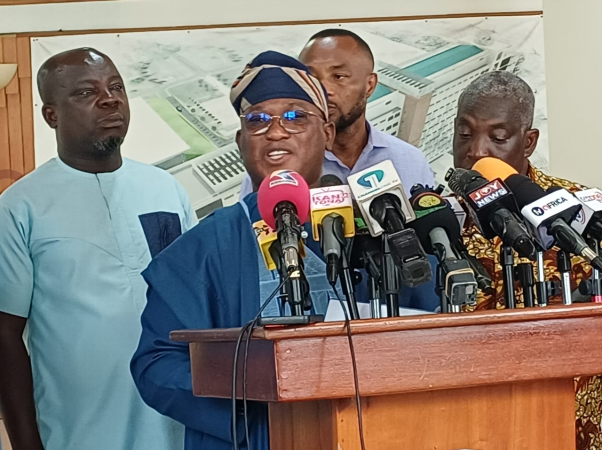
Speaking in Accra, Deputy Ranking, Legal and Constitutional Affairs Committee, Alhassan Tampuli framed the issue as more than a legal disagreement, describing it as part of a broader pattern that threatens the independence of the OSP. The caucus maintains that the anti-corruption body—established to operate free from executive influence—is now facing institutional pressure that could weaken its mandate.
A central legal question underpins the Minority’s case: whether a High Court can, in effect, curtail the powers of an institution created by an Act of Parliament on constitutional grounds. They argue that under Article 130 of the 1992 Constitution, only the Supreme Court has exclusive jurisdiction to interpret such constitutional matters. If that position holds, the ruling could be set aside, reinforcing the hierarchy of courts and clarifying limits on judicial authority.
The political dimension is equally pronounced. The Minority is calling on President John Dramani Mahama to publicly clarify his stance, arguing that there is a disconnect between stated support for anti-corruption efforts and the posture taken by the Attorney-General in court.
Implications for governance and the economy
Beyond the courtroom, the stakes are broader. The credibility of Ghana’s anti-corruption framework is closely tied to investor confidence and fiscal discipline. An effective, independent prosecutor can deter misuse of public funds, improve procurement integrity and reduce leakages—factors that directly affect public finances and economic stability.
If the OSP’s authority is weakened or perceived as politically constrained, the consequences could be tangible: higher governance risk premiums, reduced foreign investment appetite, and diminished confidence in public institutions. Conversely, a clear and authoritative Supreme Court ruling could strengthen legal certainty and reinforce Ghana’s institutional credibility.
A test for constitutional order
At its core, the episode is shaping into a test of Ghana’s constitutional architecture—how power is distributed between the executive, legislature and judiciary, and how independent institutions are protected in practice.
For the Minority, the issue is straightforward: the OSP was created precisely to insulate corruption prosecutions from political control. Any move—legal or otherwise—that appears to reverse that design raises fundamental questions about accountability.
For Ghana’s democracy, the outcome may set a lasting precedent—not just for the OSP, but for how far institutions can operate independently in a system where law, politics and public interest increasingly intersect.