
BoG cuts monetary policy rate to 21.5 percent as lending costs ease
By Eugene Davis
The Bank of Ghana has announced that the economy continues to show strong growth, with real GDP expanding by 6.3 percent in the second quarter of 2025, up from 5.7 percent in the same period last year, according to the Ghana Statistical Service.
Non-oil GDP rose even faster at 7.8 percent. Growth was driven mainly by the services sector, which grew by 9.9 percent, and agriculture, which expanded by 5.2 percent.
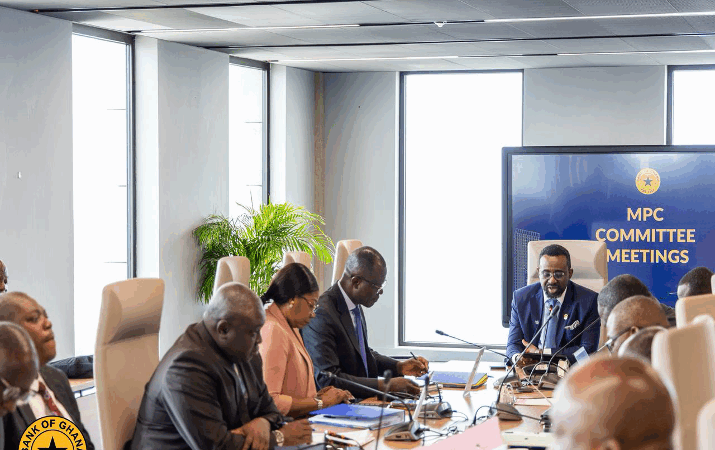
In a press statement from the Monetary Policy Committee (MPC) held its 126th meeting from September 15 – 17, 2025, to evaluate recent economic developments and assess risks to the outlook for inflation and growth, the central nbank reports that economic activity remains strong, with its Composite Index of Economic Activity rising 6.1 percent in July compared to 1.9 percent a year earlier. Business and consumer confidence also improved, while the Purchasing Managers’ Index signalled increased orders and better business conditions.
Inflation eased further to 11.5 percent in August, the lowest in four years, marking eight consecutive months of decline. The drop was supported by prudent monetary policy, fiscal consolidation, a stronger cedi, and improved food supply.
Contrary to earlier projections of a global economic slowdown, growth has been resilient supported by a modest tapering of the tensions associated with the tariff wars, robust exports in the first quarter of the year, easing credit conditions, and fiscal expansion in some Advanced Economies. Against this backdrop, the IMF revised its global growth projections for 2025 to 3.0 percent, compared with earlier forecast of 2.8 percent.
This notwithstanding, geopolitical uncertainties, relatively high tariffs and projected decline in global trade could dampen near-term growth prospects. Global inflation is expected to decline amid lower food and energy prices, as well as a slowdown in employment growth. In addition, global financing conditions have eased somewhat supported by declining policy rates, lower long-term bond yields, and a strong rebound in portfolio flows to emerging market and developing economies. Current global conditions and uncertainties have led to a strong rebound in gold prices with positive implications for Ghana’s external sector position.
The Bank’s main core inflation measure, which excludes energy and utility items, also declined, reflecting continued easing of underlying inflationary pressures. Similarly, inflation expectations among consumers, businesses, and the banking sector all eased, affirming the disinflation process going forward.
Interest rates are declining on the money market in response to the recent cut in the monetary policy rate. Yields on the money market instruments have declined significantly and the average lending rates are gradually easing, which should lower the cost of credit in the near-term. The interest equivalent of the 91-day treasury bill instrument eased from 13.4 percent at the end of July 2025 to 10.3 percent at the end of August 2025. The average lending rate over the same period went down from 26.6 percent to 24.2 percent.
Fiscal policy implementation in the year to July 2025 reflected strong consolidation efforts underpinned by tight expenditure controls, although revenues fell short of target.
Consequently, the overall fiscal deficit on commitment basis was 1.1 percent of GDP, outperforming the target deficit of 2.1 percent of GDP. Also, the fiscal anchor, that is, the primary balance on commitment basis, recorded a surplus of 1.0 percent of GDP, reflecting a better outturn than the targeted surplus of 0.5 percent of GDP. The deficit was largely financed from domestic sources. At end-July 2025, the total public debt stood at 44.9 percent of GDP down from 61.8 percent of GDP at end-December 2024.
The banking sector recorded strong performance over the first eight months, with continued asset growth and improved profitability, asset quality, and efficiency indicators. The industry’s Capital Adequacy Ratio (CAR), without regulatory reliefs, increased to 17.7 percent in August 2025, from 10.2 percent in August 2024. The industry’s Non-performing Loan (NPL) ratio improved to 20.8 percent compared to 24.8 percent last year, due to growth in bank credit and contraction in NPL stock. This notwithstanding, elevated credit risk remains a major concern. In the outlook, adherence to the recapitalisation plans and full implementation of the Bank’s regulatory guidelines to lower NPLs will further enhance resilience of the banking sector.
The external sector strengthened in the first eight months of 2025, with a significant trade surplus of US$6.2 billion, compared to US$2.1 billion recorded during the same period in 2024. This was driven by a sharp increase in exports earnings, mainly gold and cocoa, which far outpaced import growth. The reserve position remained strong with Gross International Reserves at US$10.7 billion (4.5 months of import cover) as at end August 2025, compared with US$8.98 billion (4.0 months of import cover) at end-December 2024. In the outlook, the external sector is projected to broadly remain resilient, anchored on favourable commodity prices and improvement in remittance inflows.
On the back of the strong external sector performance and increased reserve accumulation, the cedi strengthened against the major trading currencies in the year to July 2025. Subsequently, the cedi came under some demand pressure, bringing the cumulative appreciation through 12 September 2025 to 21.0 percent against the US dollar. The cedi remains among the strongest currencies globally year-to-date, reflecting prudent monetary policy, effective liquidity management, fiscal consolidation, and increased foreign exchange inflows.
Given the current state of macroeconomic conditions, the view of the Committee was that inflation will continue to ease in the near term. In the outlook, headline inflation is expected to drop to within the medium-term target of 8 ± 2 percent by the end of the fourth quarter. However, the possible upward review of utility tariffs could exert some price pressures in the medium term. Notwithstanding this, maintenance of an appropriate monetary policy stance, strong sterilisation efforts, ongoing fiscal consolidation, and adequate reserve buffers should sustain the disinflation process.
Given these considerations, the Committee, by a majority decision, voted to lower the Monetary Policy Rate by 350 basis points to 21.5 percent. The Committee will continue to monitor macroeconomic developments and take the appropriate policy decision as and when necessary to reinforce the disinflation process.
Additional Measure
The Net Open Position Limits for banks have been adjusted as follows:
Single currency NOP limit is revised from ± 5 percent to between 0 percent and –10 percent, effective 1 October 2025