
By Eugene Davis
The Minority Caucus on the Foreign Affairs Committee of Parliament has cautioned government over its agreement with the United States on Third-Party Deportees, warning that it risks portraying Ghana as aligned with the U.S. government’s controversial immigration enforcement regime.
According to the Caucus, associating Ghana with policies widely criticized as harsh and discriminatory could have far-reaching negative implications for the country’s international image, diplomacy, and human rights standing.
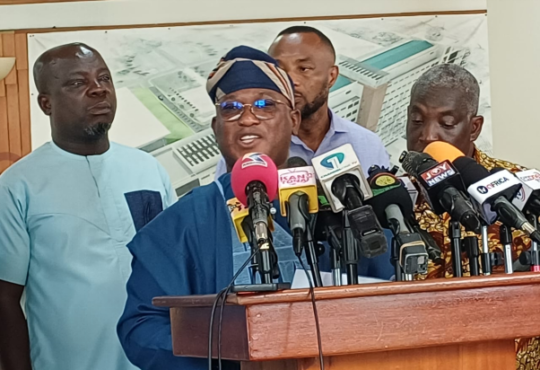
Addressing members of the Parliamentary Press Corps at Parliament House, the Ranking of the Committee, Samuel Abu Jinapor also noted that the government’s conduct in operationalizing the agreement with the United States without parliamentary ratification is a direct constitutional violation of Article 75 and an affront to the authority of the Supreme Court; “It is therefore deeply concerning that the Government continues to operationalize the agreement with the United States despite this flagrant constitutional breaches. Such conduct reflects a lack of respect for the rule of law, which is one of the fundamental pillars of our constitutional democracy.
Beyond this blatant constitutional breach, the agreement raises pressing concerns of sovereignty, security, and policy. While regional integration remains a core value of our foreign policy, it cannot be stretched to justify the forced reception of foreign nationals deported from other countries. The ECOWAS Protocol on Free Movement concerns voluntary travel, not forced deportations orchestrated by a non-ECOWAS State.”
On the international stage, Mr. Jinapor warned that the government’s agreement with the United States on Third-Party Deportees carries alarming foreign policy consequences. He stressed that Ghana has, for decades, built a proud reputation for principled diplomacy rooted in non-alignment, regional solidarity, and respect for human rights.
“Serving as a receiving point for West African deportees from the United States risks Ghana being seen as aligning with an immigration regime widely criticized as harsh and discriminatory. Associating Ghana with such policies could have serious diplomatic and human rights implications,” he said.
The Minority therefore called for the immediate suspension of what they described as the unconstitutional implementation of the agreement, pending full Parliamentary ratification and public clarity on its safeguards, security implications, and legal basis.
They further argued that under the Constitution, there is no distinction between agreements and Memoranda of Understanding (MoUs), citing the Banful case and the Brogya Gyamfi v. Attorney-General ruling to emphasize that all such arrangements require Parliamentary approval before implementation.
On foreign policy and the Gaza conflict, the Minority expressed concern over the Minister for Foreign Affairs’ recent remarks labeling the situation in Gaza as “genocide” and openly siding with one party to the conflict. While acknowledging the need for Ghana to uphold humanitarian values, they cautioned that such unilateral declarations risk undermining Ghana’s longstanding tradition of neutrality, credibility, and peace-building diplomacy.
They reminded government that since independence, Ghana’s foreign policy has been guided by non-alignment, mutual respect, peaceful coexistence, and adherence to international law. Any deviation, they warned, could compromise Ghana’s moral authority and diminish its standing as a respected mediator on the global stage.
“Ghana’s enduring strength lies in its ability to remain neutral and credible, even when global powers seek to draw us into their competing blocs. Departures from this tradition risk eroding our authority and harming our national interests,” the Minority concluded, urging government to exercise caution, consistency, and balance in articulating Ghana’s foreign policy positions.