IFS warns rice farmers face low productivity due to limited use of certified seeds


By Eugene Davis
A new study by the Institute for Fiscal Studies (IFS) has revealed that less than five percent of Ghanaian rice farmers currently have access to certified seeds, a challenge that continues to undermine productivity and competitiveness in the sector.
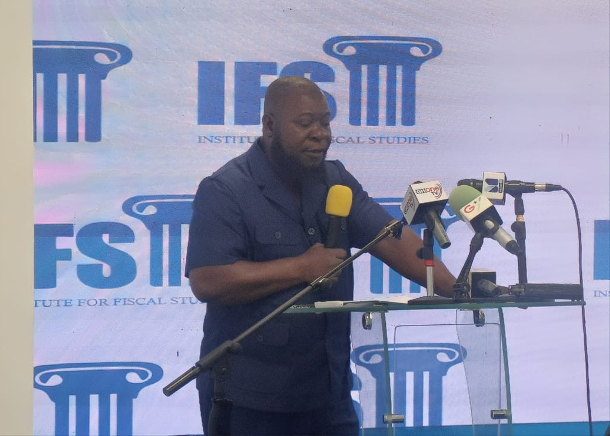
Presenting the findings under the theme “Increasing Importation of Rice in Ghana: Can the Country Transform its Fortunes in the Rice Sector?”, Dr. Said Boakye, Senior Research Fellow and Acting Executive Director at IFS, said rice importation has been a persistent concern since the 1960s due to its implications for the economy and food security. Despite several policy interventions, imports have continued to rise sharply in recent years.
“Today, fewer than 5% of farmers can access certified seeds from approved sources. Many are reverting to on-farm seed saving — a practice that risks reducing productivity and reversing past food security gains,” Dr. Boakye stated.
He noted that the government’s decision to maintain a privatized approach to seed production and distribution, introduced under the Economic Recovery Programme, has failed to deliver the desired results. “Despite clear evidence that the privatization model is not working for Ghana’s seed industry, government still clings to it. This is incredible,” he remarked.
Mechanization and Productivity Gaps
Dr. Boakye identified low mechanization as another major obstacle to Ghana’s rice production. According to the study, 67% of rice-growing districts still rely on rudimentary tools such as cutlasses and hoes, while only 6% use advanced machinery like tractors, transplanters, and harvesters.
In contrast, Vietnam’s Mekong Delta, which accounts for more than half of that country’s rice output and 90% of exports, has achieved near-total mechanization — with almost 100% mechanized land preparation and 99% mechanized harvesting during key seasons.
The IFS attributes Ghana’s low mechanization levels to policy inconsistency, limited irrigation infrastructure, and low private-sector investment. These, it said, have hindered efforts to scale up production and reduce costs.
Comparative Analysis with Thailand and Vietnam
Although Ghana has made progress — increasing average yields to 3.3 metric tons per hectare between 2019 and 2022, briefly surpassing Thailand — it still trails behind both Thailand and Vietnam overall.
Ghana’s rice area remains small, ranging from 37,000 to 328,000 hectares, compared with Thailand’s 6.6 to 11 million hectares and Vietnam’s 4.8 to 7.7 million hectares. Despite having more agricultural land than Vietnam, Ghana dedicates only 0.3% to 2.6% of it to rice cultivation, while Thailand and Vietnam allocate 43%–92%.
Vietnam’s success, Dr. Boakye explained, is rooted in yield improvement and efficient land use, while Thailand’s advantage lies in large-scale cultivation.
Ghana’s Missed Opportunities
Since 2008, Ghana’s rice production has grown due to the implementation of the National Rice Development Strategies (NRDS I & II). Production of milled rice jumped from 181,152 metric tons in 2008 to 530,887 metric tons in 2018 — surpassing CARD’s continental target of doubling output.
However, imports have also surged, rising from 394,998 metric tons to 830,546 metric tons over the same period. Dr. Boakye described this as evidence that Ghana’s policy ambitions remain modest, even though the country has immense untapped potential.
With 5.9 million hectares of fertile land — about 47% of total agricultural land — Ghana could produce 35.4 million metric tons of paddy rice annually if it achieved yields similar to Vietnam’s 6.0 metric tons per hectare. That would represent a 2,665% increase over 2022 output and place Ghana on par with major exporters like Thailand and Vietnam.
Based on consumption patterns, he estimated that Ghana could have exported 6.6 million metric tons of milled rice in 2022, equivalent to Vietnam’s export volume, which earned US$3.2 billion.
Way Forward
Dr. Boakye urged the government to adopt a bold, medium-term goal of positioning Ghana as a net exporter of rice, capitalizing on its abundant land, labor, and growing global demand.
Among his recommendations were:
Mobilizing youth into large-scale rice farming.
Producing and marketing local aromatic rice seed varieties to reduce dependence on imported brands.
Reassessing the privatization model in the seed industry.
Promoting mechanization and irrigation to expand production and reduce costs.
With the right policies and investments, he emphasized, Ghana can transform its rice sector from a net importer’s dilemma into a regional export success story.