
By Eugene Davis
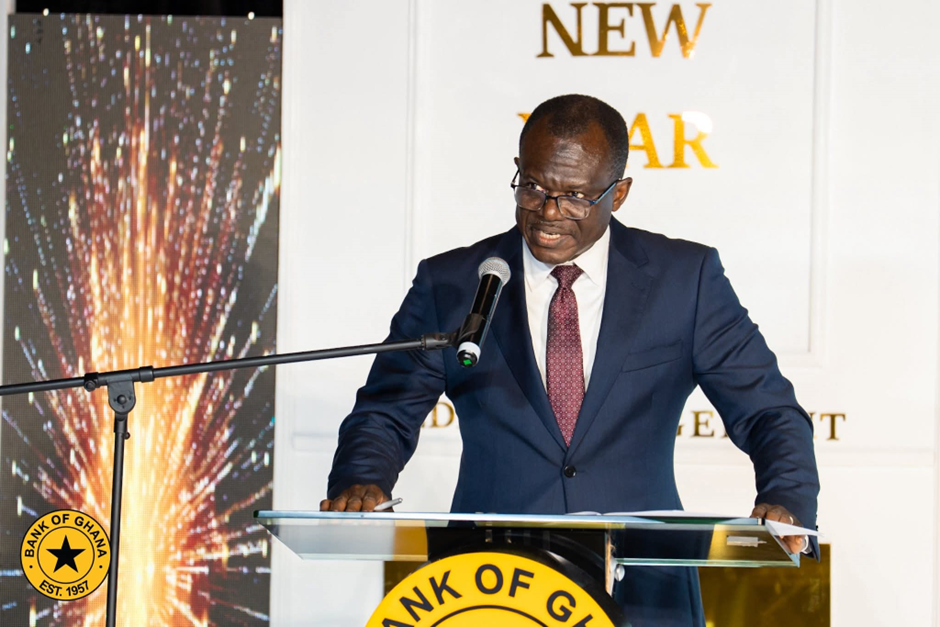
Dr. Zakari Mumuni, First Deputy Governor of the Bank of Ghana, has called on the media to report on developments in the foreign exchange market with greater context, cautioning that poorly framed stories can fuel anxiety and trigger fear-driven behaviour.
According to him, the role of the central bank goes far beyond day-to-day banking. The Bank of Ghana regulates financial institutions, manages the national currency, provides banking services to government and, above all, safeguards financial stability. Because of this, he stressed, how the Bank’s actions are interpreted and reported matters deeply.
“Sensational headlines can amplify anxiety. Reporting without full context can distort understanding. But responsible journalism has the power to stabilise expectations and strengthen public confidence,” he noted.
Dr. Mumuni was speaking at the Governor’s New Year Media Engagement in Accra, where he addressed the impact of media reportage on the Bank of Ghana’s operations and market behaviour. He said this responsibility is most evident in reporting on the foreign exchange market.
Ghana, he explained, operates a managed floating exchange rate regime, where modest daily movements in the cedi are normal and reflect routine market trading rather than economic distress. However, when these movements are reported without explanation, they can create unnecessary panic.
“People rush to protect value. Demand spikes without justification. Volatility rises. And confidence in the currency weakens—not because economic fundamentals have changed, but because sentiment has shifted,” he said.
“In that sense, reporting itself becomes a market signal.”
He added that the reverse is also true. When reporting is measured and well-contextualised, calm is reinforced, rational behaviour prevails and markets function more efficiently.
Dr. Mumuni also stressed that currency stability is not an abstract macroeconomic concept but something that directly affects the lives of ordinary Ghanaians. A stable cedi, he noted, helps ease import prices, moderate transport costs and bring greater predictability to expenses such as school fees, rent, medicines and food. It allows businesses to plan and price with confidence, gives investors certainty, and enables workers to save without fear that their earnings will rapidly lose value.
Reflecting on recent performance, he said the cedi ended 2025 significantly stronger, supported by improved economic fundamentals, disciplined policy measures and renewed confidence in the policy framework.
“This was not a victory for the central bank alone. It was a shared national gain,” he said. “Just as instability hurts everyone, stability benefits everyone.”
For that reason, he argued, protecting the cedi cannot be the responsibility of one institution alone. It requires the collective effort of policymakers, businesses, households—and the media.
Touching on reports about central bank losses, Dr. Mumuni said context is equally critical. Around the world, central banks incur losses when they take decisive actions to stabilise economies during crises. Such outcomes, he explained, reflect deliberate policy choices made in the public interest, not financial recklessness.
“When this distinction is not clearly explained, public trust can be undermined,” he cautioned, adding that trust is the foundation upon which effective monetary policy rests.
He urged the media not to lose sight of the broader policy outcomes that matter most to citizens—declining inflation, rebuilt reserves and a stronger currency.
Dr. Mumuni reminded journalists of the power of their work.
“Every headline matters. Every story sends a signal. Every analysis shapes expectations,” he said.
“The question is not whether the media should report on the Bank of Ghana—you must. The real question is how. Does the story illuminate or inflame? Does it build understanding or amplify fear? Does it strengthen confidence, or unintentionally weaken it?”
He urged the media to exercise care and responsibility in drawing conclusions, noting that history has shown how economies can be stabilised—or destabilised—by the way economic information is communicated.
“Let us choose the path that builds trust, supports stability and advances Ghana’s collective progress,” he added.