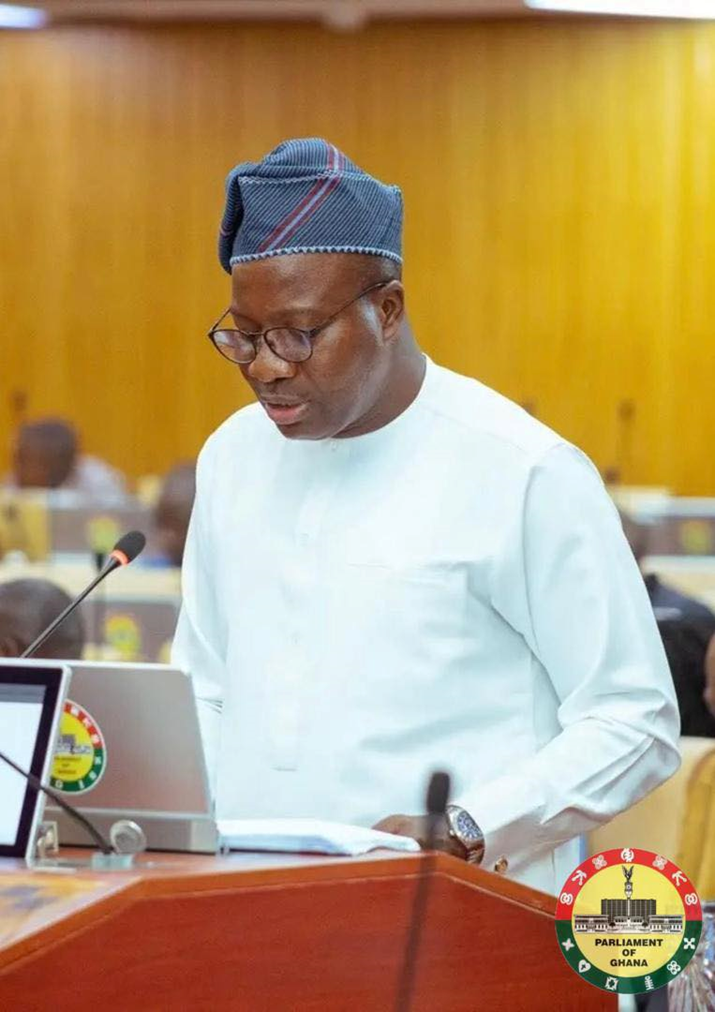

Ghana’s Parliament has passed the 24-Hour Economy Authority Bill, 2025, a flagship legislative plank of the new administration’s jobs agenda, with Majority Leader Mahama Ayariga arguing that the policy will help absorb the country’s growing youth unemployment by extending economic activity beyond traditional working hours.
Mr Ayariga said the proposed 24-hour model — a central campaign promise of the governing National Democratic Congress (NDC) — is intended to transform production patterns, increase shift work and create more employment opportunities across industry, services and exports.
“If the country is working 24 hours, it means we will need more labour,” he said during debate on the floor of Parliament. “Work will be done in shifts — day and night — and that translates into more jobs and livelihoods for our young people.”
The legislation establishes a dedicated authority to coordinate what government describes as the 24-Hour Economy and Accelerated Export Development Programme — a strategy aimed at lifting productivity, supporting round-the-clock operations and boosting Ghana’s export competitiveness.
According to the Majority Leader, the authority will serve as the central organising body, aligning policies, institutions and investment to ensure that factories, logistics, agro-processing and services can operate continuously where viable.
“This is about creating jobs and opportunities for the youth who voted for change,” he said, adding that the country must deliberately expand production hours if it is to generate employment at scale.
The government argues that the move comes at a time when unemployment and underemployment remain elevated, particularly among graduates. Officials say years of macroeconomic instability — including high inflation, currency volatility and tighter credit conditions — constrained private sector expansion and reduced hiring.
Mr Ayariga said the administration had begun stabilising the broader economy through fiscal reforms and fresh capital injections into state-owned banks, including ADB and NIB, to restore lending to businesses. The new authority, he added, would provide the legal and institutional framework to anchor the next phase of growth.
“We operate under the law. To formalise and implement the 24-hour economy, there must be a legal mandate,” he said.
Economic implications
Economists say the concept of extended production hours could, in theory, raise capacity utilisation in manufacturing and agro-processing — sectors where idle equipment and seasonal bottlenecks often limit output. More shifts can mean higher productivity without proportionate increases in fixed costs, particularly in export-oriented industries such as cocoa processing, light manufacturing and logistics.
For Ghana, where exports and industrialisation remain central to foreign-exchange earnings, improving turnaround times at ports, warehouses and factories could strengthen competitiveness and attract investment.
However, analysts caution that round-the-clock operations depend less on legislation and more on reliable power supply, transport, security, labour flexibility and access to finance.
The bill drew opposition from the Minority, which questioned whether creating a new authority was necessary to achieve those goals.
Kojo Oppong Nkrumah, MP for Ofoase-Ayirebi, argued that major global cities with 24-hour economies — including New York, Tokyo and Dubai — did not establish standalone authorities to make them function.
“What this bill does is set up a bureaucracy — a chief executive, a board, staff and a budget,” he said. “It does not, by itself, create a 24-hour economy.”
He warned that the new body could duplicate the work of existing agencies, particularly in export promotion, and add administrative costs without delivering tangible employment gains.
The debate underscores broader questions about how best to tackle job creation in an economy still recovering from recent financial and fiscal strains. While the government sees coordination and policy direction as critical, critics argue that improving the business climate and infrastructure may matter more than institutional expansion.
For many young Ghanaians, the test will be practical rather than legislative: whether factories run longer hours, businesses hire more workers and pay packets improve.
The authority is expected to begin work later this year.